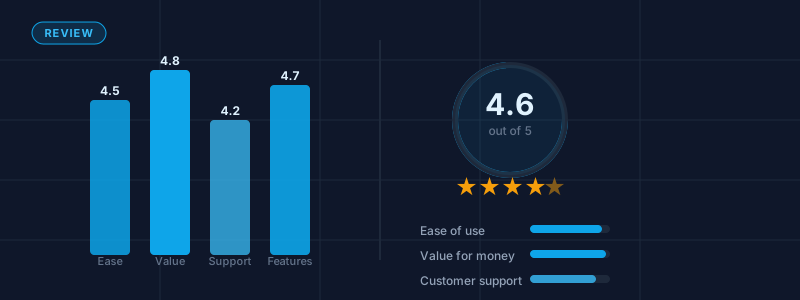
Overview
Xero is the de-facto cloud accounting platform for Australian small businesses — and that's not marketing spin. Walk into any accountant's office in Australia and you'll see Xero on the screen. The platform handles bank reconciliation, BAS lodgement, STP (Single Touch Payroll), GST, payroll, expense claims, project tracking, and connects to more than 1,000 third-party apps through the Xero marketplace. For Australian SMBs moving off spreadsheets or legacy desktop software, Xero is the obvious starting point.
That said, Xero isn't the cheapest option and the per-tier feature gates can frustrate growing businesses. This review is written specifically for Australian operators in 2026: we'll cover what Xero actually costs in AUD, the features that genuinely matter for Australian compliance (BAS, STP, GST), when Xero is the right choice, and when a simpler alternative like QuickBooks or MYOB might suit you better.
Key Features
The standout feature for Australian operators is Xero's automatic bank feed reconciliation. Xero connects directly to the major Australian banks — CBA, NAB, ANZ, Westpac, ING, Suncorp, Bendigo, Macquarie, and almost every other retail bank — and ingests transactions daily. Pending transactions appear in a coding screen where you match them to invoices, bills, or accounts. The machine-learning suggested matches are genuinely useful and save hours every month compared to manual reconciliation.
For compliance, Xero's one-click BAS and IAS preparation is exceptional. The platform pulls together your GST-collected, GST-paid, and PAYG withholding figures and generates an ATO-ready activity statement. Lodgement goes directly through Xero's ATO integration — no manual data entry into the Business Portal. The STP-enabled payroll also reports each pay run to the ATO automatically, and Xero's built-in award interpretation handles modern awards far better than most Australian payroll-only products.
Beyond the accounting core, Xero includes project tracking (assign costs and invoices to client jobs), expense claims with receipt capture through Hubdoc (a Xero-owned product), multi-currency for businesses trading internationally, inventory tracking, and a surprisingly capable mobile app that lets sole traders reconcile on the go. The 1,000+ app marketplace covers almost every tool an Australian SMB might use — from point-of-sale systems like Square to time-tracking tools like Harvest to ecommerce integrations with Shopify and WooCommerce.
Related: HubSpot Free CRM: Australia's Best Free CRM in 2026?, HubSpot Review: Is It Worth It for Australian Businesses? (2026), Best Email Marketing Tools for Australian Creators (2026), Canva Pro Review: Is It Worth It for Australian Creators? (2026), Top Project Management SaaS for Small Australian Businesses (2026)
Pricing in AUD
Xero bills in AUD natively, which means no FX confusion for Australian subscribers. Here's the current tier structure in 2026:
- Starter: ~AUD $20/month — for sole traders and very small businesses; up to 20 invoices and 5 bills per month
- Standard: ~AUD $35/month — for small businesses; unlimited invoices and bills, multi-currency
- Premium: ~AUD $62/month — for growing businesses; adds analytics, projects, and multi-entity support
- Payroll-only add-on: ~AUD $10/month per pay run — STP-compliant payroll without the full accounting suite
- Established / Enterprise: Custom pricing — for larger Australian businesses needing advanced analytics, enterprise integrations, and dedicated support
Xero offers an annual-commitment discount (typically around 10%) if you pay yearly instead of monthly. There's also a 30-day free trial on the Starter plan, which is enough time to import your historical data and decide whether the platform fits. Unlike some competitors, Xero publishes AUD pricing transparently — what you see is what you pay, with no hidden transaction fees on top.
Pros & Cons
Strengths
- Bills natively in AUD — no FX conversion or fees
- Direct ATO integration for one-click BAS and IAS lodgement
- STP-enabled payroll with award-rate interpretation
- Bank-feed ecosystem covers every major Australian bank
- Excellent mobile app for sole traders and field work
Limitations
- Price escalation as you move from Starter to Premium
- Starter tier restricts reconciliation and transaction volume
- No on-premise option — fully cloud-only, requires reliable internet
- Payroll add-on cost stacks on top of base subscription
- Learning curve for non-accountants, especially BAS terminology
Verdict
For most Australian small businesses — sole traders through to teams of 10–20 — Xero remains the right default choice. The BAS and STP integrations alone save hours each quarter and remove the risk of manual lodgement errors. Most Australian accountants and bookkeepers are already fluent in Xero, which means you're never far from help if you get stuck on a transaction.
The case for a competitor appears at specific junctures: solo freelancers with very low transaction volume may want to consider Wave or QuickBooks Self-Employed (both cheaper), while larger Australian businesses with complex multi-entity structures may find MYOB Advanced or QuickBooks Online Advanced a better fit. For everyone in between, Xero is the platform we'd recommend first.
Affiliates note: Xero runs a recurring-commission program on Commission Factory and pays out per paid subscriber. We only recommend Xero for Australian operators who genuinely need cloud accounting — but if it's the right tool for your audience, you can sign up via our tracked link below and we may earn a commission at no cost to you.
You might also like
Xero handles the books; HubSpot's free tier handles the pipeline — the free sibling for AU Xero operators pairing accounting with a real CRM.
If you've outgrown the free Xero-adjacent CRM, the full HubSpot platform is the natural next step for service-business operators.
Mailchimp, ActiveCampaign, and ConvertKit compared on pricing, deliverability, and the affiliate stack we recommend for AU Xero operators.